Showing posts with label Week Three. Show all posts

Monday, February 2, 2015

Storybook Styles

Jason and Medea by Carle van Loo (1759).
For my storybook, I am going to combine a couple of my ideas to make a storybook concentrating on ancient couples. I plan on including a story about Hypermnestra and the drama surrounding her failure to kill her husband, a story about Hector and Andromache, and a story about Medea and Jason. I am unsure what couple I would like to focus my last story on, but I want to display a variety of relationships. I love that Hypermnestra gets a storybook ending, but I love the tragedy of Medea and Jason's story. I am considering doing a story on either Paris and Helen, or Orpheus and Eurydice. I think they both have pretty intriguing stories that I would love to be able to explore.

I want to tell my stories in first person. I like being able to get into the mind of a character and really explore individual perceptions of events. I am choosing characters and relationships that have really powerful stories to be told and I think one of the best ways to do justice to these stories and to really help people to see and be moved by them is to put them directly inside of the minds of the people who lived them.

One idea I have for the story is to organize it into a frame shift. I would have a woman who has uncovered a collection of ancient diaries, and each story would be written as a diary entry or several diary entries from one of the women (Hypermnestra, Andromache, etc). I like the idea of having someone reading diary entries from these women because I think it would cool to also get to write about how the stories affected the woman reading them, its allows for a secondary way to portray the relationships of the characters.

I also like the idea of putting the stories into letter format. I think it would be cool particularly for the story of Hypermnestra to display the correspondence between her and her husband, and reveal the story through each of their letters. For the story of Medea and Jason I would love to tell Medea's side of the story in a letter she leaves in her home prior to her escape on the chariot. She is a character about whom I have conflicted feelings. I sympathize with her on many accounts, but her killing her children and getting away with it leaves such an unsettling feeling at the end of her story. She is a character I would love to get inside of and to give her a chance to tell her side of the story.

I am also toying with the idea of organizing my storybook to be more of an anthology. I like the freedom of an anthology. Because each of these couples' relationships and stories are so different, I like the idea of being able to tell each one in a different way. I think Medea's story could be so easily and powerfully told through a series of diary entries, but Hypermnestra's story fits so well in a correspondence format. I picture her writing a letter to her husband confessing to the plot her father made against him, and begging for his support at her trial.

Finally the idea of using an anthology and simply writing each of the stories in first person real time as they happen could be really powerful. I like this method because it is simple. There aren't any excess details which can detract from the power and the lessons of each person's story. I have chosen these couples because I am so moved and intrigued by the stories they have to tell, by their minds, their feelings, and their actions. I like the idea of just telling the story, from their perspective, with their candid thoughts, feelings, and actions as they happen. I think telling stories this way can sometimes lend a feeling of credibility. honesty, and identification to the characters.

BibliographyThe Medea  by Euripidies, translated by David Grene and Richard Lattimore (1944). Print.

"Hypermnestra to Lynceus" by P. Ovidius Naso from The Epistles of Ovid translated by J. Nunn, R. Lea, and J. Rodwell (1813). Web Source: Perseus Digital Library

"Hector and Andromache" from Homer's Iliad, translated by Alfred J. Church (1907). Web Source: Un-Textbook

"Orpheus and Eurydice" from Age of Fable: Vol I & II: Stories of Gods and Heroes by Thomas Bulfinch (1913). Web Source: Bartleby


Thursday, January 29, 2015

Essay: The Portrayal of Women in Cupid and Psyche

Venus Punishing Psyche with a Task by Luca Giordano (ca. 1692-1702)
The portrayal of women in stories and literature has evolved drastically since ancient times. In ancient stories and literature there is a pattern of women being portrayed as weak and naive as well as being made out to be slaves to their baser instincts. This pattern is a testament to the low status that women held in Ancient Greek and Roman cultures. Aristotle, one of the world's greatest philosophers even once claimed that women were in fact "deformed men". In the Cupid and Psyche unit, two of the main characters Psyche and Venus are women, and even though the play a large role in the story, the ancient attitude of the inferiority and weakness of women is readily present.

Throughout the story Psyche is presented as a woman of astonishing beauty. There is even a section in the story dedicated explicitly to describing how people abandoned their worship of Venus, the goddess of beauty, and began to worship Psyche as though she were a goddess. While heralding Psyche for her incredible beauty may seem positive, the mention that she had caused people to abandon their love for Venus, one of their gods, incites ideas that she is a seductress, a trait that is not highly viewed in classical societies.

Beyond Psyche's beauty almost no other positive characteristic is described about her. Instead she is portrayed as a beautiful but naive, disobedient, and weak woman. Her husband constantly has to warn her not to believe the words of her sisters (who are also interestingly enough portrayed as the bad guys of the story) and not to try to find out what she looks like. She seems to have no thoughts of her own except to willingly believe what everyone else tells her. Every time she is faced with a problem her first instinct is to weep until someone comes along to solve it for her. This is so clearly a representation of women in society at the time. They were regarded as property, as serving no real purpose except to carry children, items to be seen and not heard.

Even being a goddess, Venus, the other major female character in the story, could not escape a negative and misogynistic portrayal. She was made to possess all of the qualities attributed to women which Psyche did not fulfill.  Venus was jealous, vindictive, and irrational. Beyond being weak and stupid, women in Classical societies were thought to be slaves to their base instincts, basically animals. The characteristic possessed by Venus in this story, directly corroborate that ideal. Upon seeing Psyche, Venus is so full of jealousy she immediately seeks to destroy her. She devises a plan for Psyche's demise and charges her son with the task, and when her son goes against her wishes she proves to be vindictive and violent. There is nothing positive about Venus's character in this story at all.

Throughout the story of Cupid and Psyche, the only positive characteristic attributed to any of the female characters were their beauty. Even that concession however is riddled with negativity as it ends up being the major source of strife throughout the story. The portrayal of the female characters in this story is a true testament to the misogynistic and patriarchal culture of the ancient Greek and Romans.

Links: Reading unit: Cupid and Psyche
Psyche's Beauty
Psyche's Husband Warns Her
Venus and the Goddesses
Venus and Psyche

Wednesday, January 28, 2015

Week Three Storytelling: Monster-in-Law

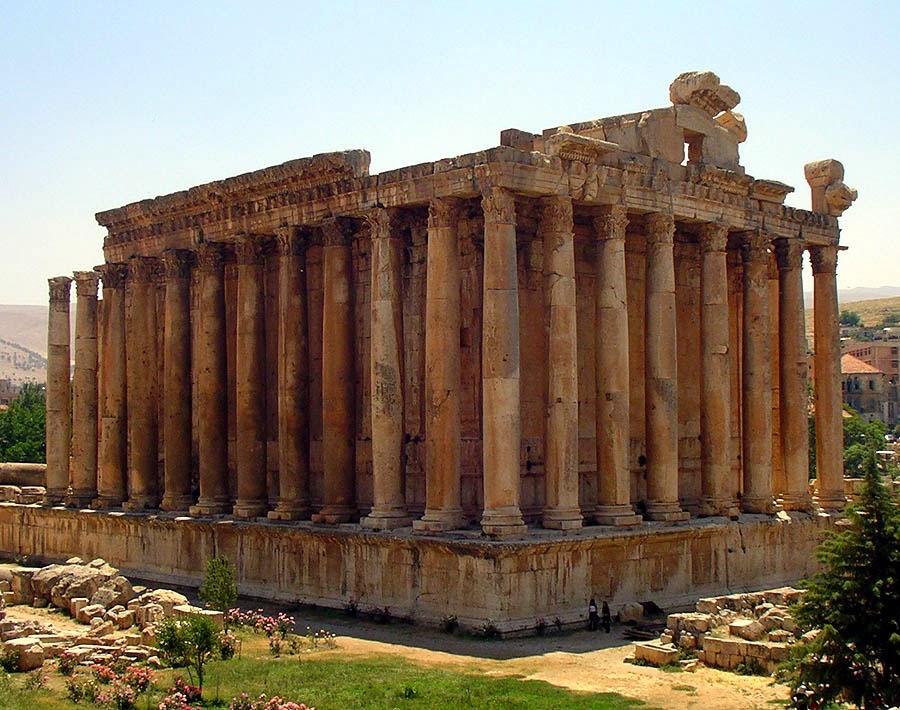
Roman Temple of Aphrodite
My hair was being pulled. Hard. Any harder and my hair was going to come out, I was sure of it. I let out an unladylike grunt as the woman manhandled me, dragging me inside of the temple. The woman yanked me to a stop, and I stumbled, bringing my arms protectively to my stomach in case I should fall.

Well, not quite the welcome I'd hoped for, I snorted to myself. When you're entering the temple of your mother-in-law, you're usually hoping for something a little warmer, but then again my mother-in-law was currently on a mission to kill me, so what did I expect? Venus was mad, and by mad I mean furious that her son Cupid had married me. (She has some sort of jealousy thing because I'm a little to beautiful for her liking, plus I'm a mortal. Ya know, the normal family issues).

Speaking of Cupid, where was that drama king anyway? I'd been looking for my impossibly angry husband for days, while simultaneously trying to prevent Venus from killing me.

Ugh, men. You have a couple little doubts when you realize you've never seen your husband's face, and suddenly its the end of the world. I mean, sure, in hindsight the whole 'he could be a giant killer serpent, so I'm gonna bring a razor to bed with me' thing may have been a little melodramatic, but it was a one time thing! Sue me. 

But here I was, in this stupid temple and in a completely desperate situation, about to beg Venus for mercy and forgiveness. I hugged my belly a little tighter, wishing I would feel that comforting flutter of a kick to know my baby was still here, that he was okay, that he was on my side.

"Well, well, well, if it isn't my precious daughter-in-law." Venus stalked toward me, her voice dripping with sarcasm as her face twisted into a smirk. Oh good gods, here we go. "Come to beg me at last have you? Or are you just here to see your husband? No matter really, I have plans for you anyway."

"Goody," I said flatly. So this is where my husband has been all of this time. Of course.

"Look at this girl. Coming here, practically parading her pregnant belly around, trying to rub it in my face that my stupid, stupid son has fathered a bastard." Venus addressed her servants.

In my defense, I was hardly parading my pregnancy. Being 8 months pregnant is a little hard to hide. Leave it to my mother-in-law to exaggerate wildly though.

"Don't even bother thinking that there is a hope in the world of me allowing that child to be legitimate. You'll be lucky if I even let this monstrosity be born." Venus went on cruelly. I hugged myself tightly, tears pricking my eyes. Buck up, Psyche, now is not the time to be getting all hormonal. I schooled my features, steeling myself against her hateful words before shooting her an icy glare. If only looks could kill.

My silence infuriated Venus, and suddenly she was attacking me, ripping at my hair, tearing at my robes, screaming in rage. I hunched protectively over my belly, curling into myself, trying only to protect my baby. Tears streamed down my face. She stopped finally, as quickly as she had started, and stepped away from me, disheveled and breathing hard. She spoke to one of her servants who ran to the kitchens to do her bidding. She stared at me coldly, until they'd come back, heaving a giant bag. "Sort these," she motioned toward the sack. "Before the evening is done. Show it to me for approval." Then she turned on her heel and took off, her servants hurrying after her.

I stood there dumbly. I was bruised, bleeding even. My clothes were tattered. What had once been a beautiful draping of sapphire silk, now hung around me in limp tatters. I stepped towards the sack, peaking into it. You've gotta be flippin' kidding me. Beans. The bag was full of beans. At least 10 different kinds. Venus wanted me to sort a giant sack of beans.

I was suddenly exhausted. The kind of exhaustion that extends all of the way to your bones. My arms and legs felt like lead. I sank to the ground, sighing a breath that ended in a sob. This was asinine. This was literally completely insane. I was sorting BEANS for my psychotic monster-in-law in the hopes that she would decide not to destroy my life, my marriage, and my child. If I didn't love my stupid, impossibly aggravating husband so much, and if I weren't carrying his baby, I would just let her destroy me. But I was in love with him, and I was carrying his baby. This precious, lovely baby I was carrying. This tiny child who comforted me with his kicks, who promised to be everything I had ever dreamed of. I would do whatever crazy thing Venus demanded of me for this baby.

I began sorting. It was slow work. I would never finish in time. But then I heard a small cough. I looked up and a child stepped out of the dark corridor leading to the kitchens. She walked toward me, looking at the sack with a pitying glance. "You'll never finish that. You better let me help." She hesitated for a moment, then held up one finger to me, signaling that I should wait, as she ran back to where she'd come from.

She came back quickly, bringing with her a hoard of other children, all varying ages. They sat down close to me, and wordlessly began passing the giant sack around until everyone had a heaping pile of beans. And then we all began to sort. Maybe I'll make it out of this ridiculous mess after all.

Authors Note: Okay so my main problem with the Cupid and Psyche unit was that as much as I wanted to really like Psyche and really root for her, she didn't seem to have much of a personality. She doesn't really think for herself and frankly, she's kind of a cry baby. I'm all about strong female characters. I like to read about women who are smart and courageous, who think for themselves, who don't whimper and simper and wait around all day waiting for someone else to give them the answers. One of my favorite scenes in this story was when Psyche finally goes to Venus to try and get everything figured out. I wanted to portray this scene in a different light though. I really wanted to turn Psyche into a strong character, someone with a personality, with opinions, and a lot of self respect and confidence. I also thought that if I was going to make Psyche more lively and outspoken that it would make more sense to give the story a more modern type of feel and attitude. So this is my take on Venus and Psyche. Thanks for reading!

BibliographyVenus and Psyche, Apuleius's Golden Ass translated by Tony Kline (2013).

Tuesday, January 27, 2015

Reading Diary B: Cupid and Psyche

Okay so I liked the Cupid and Psyche unit, I particularly loved the second half. The episodes of the story where Venus sends Psyche on all of those crazy tasks was really fun to read, particularly because many of the tasks are familiar to me from modern fairy tales. The first task given to Psyche by Venus required her to sort a bunch of beans into their particular types. This is very similar to the task that the step-mother in Cinderella forces Cinderella to do if she wants to go to the ball.

Depiction of Psyche entering the underworld
in Psyche aux enfers by Eugene-Ernest
 Hillmarcher (1865)
I liked how the story portrays Psyche as very determined. She is able to complete all of the tasks (with some help from animal friends), all of the while she is desperately searching for Cupid. I particularly liked the final task given to Psyche. She is to travel to the underworld to obtain a bottle of Beauty from Persephone. There were so many stipulations that she had to follow in order to ensure her safe passage back to the world of the living, and she was prudent enough to follow all of those without question or hesitation. That shows determination. But she couldn't seem to resist opening the jar of Beauty even though she was warned not too. Honestly that kind of annoyed me. I mean, come one. You make it all of the way back from the Underworld with literally only one thing left to do, and you can't manage to do it? She's already the most beautiful woman in the world, why is she so willing to ignore the warning to potentially get just a little bit more beauty?

Also there is just one thing that I could not get over in the story. Psyche cried the entire way through it. Honestly, drives me nuts that women in ancient literature are always crying. I mean, come on. Toughen up. I would love for there to be a remake of this story where Psyche is just a little bit less emotional, and a lot more rational.

Reading Diary A: Cupid and Psyche

This reading unit (Cupid and Psyche) is really cool so far. I love that this is considered to be the first fairytale. The similarities to Beauty and the Beast are so easily apparent. I particularly like that episode of the story Psyche's Husband Warns Her of Danger as well as Psyche's Husband Revealed.

Psyche and Cupid depicted in Psyche et l'Amour
endormi
 
by Peter Paul Rubens (1636)
After the Psyche sees that her husband is Cupid and not some monstrous snake, her shame is so evident. She is almost frantic. She tries to hide her knife in the top of her dress but it flies out of her hand in her rush. The description of her actions after her reveal give the image of someone so frazzled and surprised into shame and remorse. I like this depiction because I think it is revealing of Pysche's character. She is a woman caught in a very strange situation. She is alone and lonely, and in love with a man she has never seen before. This would be a stressful situation, one in which it would be easy for people to instill fear and doubt within her, and her sisters do just that.

I think the depth of her shame and her remorse of bringing the knife to bed upon seeing her husband is evidence of how vulnerable she was to her sisters' claims, as well as how relieved she must feel to know her husband had been telling her the truth, and trying to protect her against her sisters' lies.

I found it really interesting that she pricked herself with one of Cupid's arrows as well. It was an added element to the story that I did not forsee. Psyche already seemed to be falling in love with Cupid in the dark nights when he came to her. That while she was trying to reconcile her husband's identity with the plot her sisters' had created for her, she pricked her finger and fell more deeply in love with Cupid adds some tragedy to the story.

Cupid had warned her that if she tried to see his face there would be dramatic and serious consequences. Her breaking those rules and then fall uncontrollably further in love with him almost seems a cruel trick, particularly when it is easy to predict what will likely happen next, Cupid's departure.